
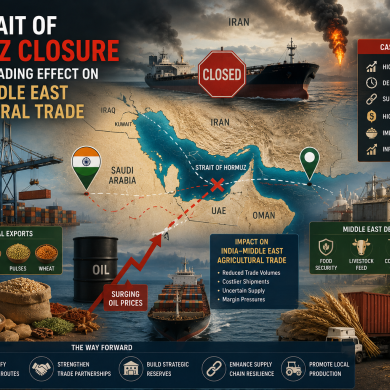
The US–Iran tension, which has persisted at varying levels of intensity since the 2018 withdrawal from the JCPOA nuclear agreement, entered a new phase in 2024–25 with intermittent naval incidents in the Persian Gulf and Houthi missile activity in the Red Sea affecting commercial shipping on key India–Europe trade routes. For Indian exporters whose Gulf market revenues depend on uninterrupted maritime access, the risk calculus has changed.
The Red Sea Disruption Context
Since late 2023, Houthi attacks on commercial vessels in the Red Sea — framed as solidarity actions in the context of the Gaza conflict — have rerouted a significant share of container traffic away from the Suez Canal and around the Cape of Good Hope. This is distinct from, but connected to, the Hormuz risk: the cumulative effect on India–Gulf trade lanes has been higher freight costs, longer transit times, and elevated insurance premiums on cargo moving in both directions.
Impact on the India–Gulf Agri Trade
- War risk insurance premiums: Rose from approximately 0.01–0.02% of cargo value in 2022 to 0.05–0.15% during peak tension periods in 2024–25
- Gulf Risk Surcharges: Shipping lines added surcharges ranging from $100–$300 per TEU during elevated risk periods
- Reinsurer restrictions: Some European reinsurers restricted coverage for vessels entering defined exclusion zones — affecting route options for carriers
How Indian Exporters Are Responding
Experienced exporters to the Gulf have adopted several practical responses to elevated maritime risk: shifting to shorter-credit-term or advance-payment terms for Gulf buyers in higher-risk periods; engaging ECGC credit insurance to protect receivables; moving to CIF rather than FOB terms where possible, shifting the freight and insurance burden to better-resourced buyers; and exploring direct air freight for high-value, time-sensitive product lines where the economics permit.
The Broader Opportunity
Paradoxically, sustained regional disruption has increased the strategic value of Indian suppliers to Gulf buyers. Proximity — India’s close maritime relationship with the Gulf — means that even under disrupted conditions, Indian suppliers can deliver faster than European or American alternatives. Gulf buyers facing supply chain pressure are, in some cases, deepening their relationships with Indian exporters rather than diversifying away — recognising that the India–Gulf corridor remains more resilient than alternatives despite elevated risk.




Add comment