
India’s agricultural exports grew 2.3% to $53.1 billion in 2025–26 — surpassing $50 billion for the first time — even as the United States imposed tariffs of up to 50% on Indian goods during the same period.
The headline figure for FY 2025–26 is striking not merely because of its size, but because of the conditions under which it was achieved. Against a backdrop of aggressive US tariff policy, Red Sea shipping disruptions, and tightening regulatory barriers in the EU, India’s agricultural and processed food export sector delivered its strongest performance on record. This overview examines what drove that performance, where the structural vulnerabilities remain, and what the trajectory means for international buyers who source from India.
The Numbers in Context
| $53.1 Bn Total agri exports FY 2025–26 | +2.3% Growth over FY 2024–25 | $51.9 Bn Previous year figure | ~20% Share of processed foods |
To appreciate the scale of this achievement: overall Indian merchandise exports grew just 0.9% in the same period, to $441.7 billion. Agricultural exports, at 2.3% growth, significantly outpaced total trade — a reversal of the longer-term pattern where commodity price cycles often suppress agri export value even as volumes grow.
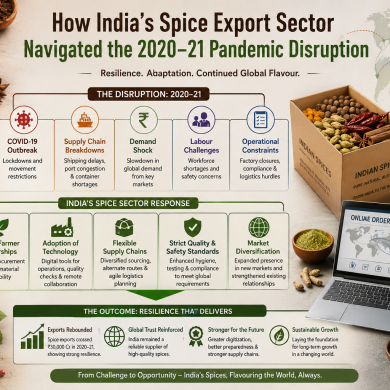
The composition of growth matters as much as the aggregate. Spice exports — including chilli, cumin, turmeric, and mint — grew strongly, continuing a multi-year trend toward both higher volumes and greater value-addition per tonne. Basmati rice surged to near-record levels, supported by the removal of export restrictions that had been imposed in prior years to manage domestic food inflation. Marine products found new destinations in China, Vietnam, Japan, and Belgium after US-bound volumes declined under tariff pressure.
The US Tariff Disruption and How Exporters Responded
The Trump administration’s tariff timeline created a volatile environment through 2025–26: a 25% tariff imposed from August 7, 2025 was raised to 50% by August 27, before being progressively rolled back to 18% in February 2026 and then 10% by late February. For Indian agri-commodity exporters, the net effect was a period of acute uncertainty in the US market lasting approximately six months.
The response from Indian exporters was swift and, in retrospect, structurally significant. Rather than waiting for a policy reversal, exporters redirected volumes toward Southeast Asia, China, Japan, Europe, and Canada. Marine product exporters pivoted particularly aggressively — Vietnam and Thailand absorbed shipments that would previously have cleared US customs. This market diversification, though initiated under pressure, has created lasting commercial relationships that are unlikely to fully unwind even as US tariffs moderated.
KEY MARKET SHIFTS IN 2025–26
- USA Tariff pressure reduced volumes of marine, garments, and jewellery; spice and rice exports partially insulated by mid-year rollbacks
- China Emerged as a significant new destination for Indian spices, certain oleoresins, and marine products
- Southeast Asia Vietnam, Thailand, and Indonesia absorbed diverted volumes across multiple agri-commodity categories
- Europe Maintained stable demand for spices, dehydrated vegetables, and organic produce despite NTB pressures
- Gulf (GCC) Continued as the largest regional market by value for processed agri products, with Halal certification as the access requirement
The Processed Foods Gap: India’s Structural Lag
One number in the 2025–26 data deserves particular attention from anyone evaluating India’s long-term export trajectory. Processed agricultural exports — value-added products beyond raw commodities — constituted approximately 20% of total agri export value. By comparison, China processes approximately 50% of its agricultural exports into value-added forms; the United States, roughly 25%.
This gap is not a new observation, but it has become more commercially significant as global buyers increasingly prefer ready-to-incorporate ingredients over raw commodities — partly for supply chain convenience, partly because certification and traceability are easier to manage on a finished ingredient than on a raw material. For categories like dehydrated vegetables, spice oleoresins, and processed natural fibres, India’s existing processing infrastructure already operates at or near global quality standards. The challenge is scale and consistency, not technical capability.
What the Record Means for International Buyers
For procurement teams evaluating Indian agri-commodity sourcing, the 2025–26 performance provides several relevant signals. First, Indian suppliers demonstrated meaningful supply chain resilience — the ability to maintain export volumes and find alternative logistics routes under conditions that disrupted more fragile supply chains. Second, the sectoral diversification of growth — spices, rice, marine, processed foods each contributing — indicates that the performance was not dependent on a single commodity supercycle.
Third, and most consequentially for buyers with long-term sourcing relationships, the Indian agri-export sector’s response to tariff disruption showed a willingness to develop new market relationships rapidly. Buyers who deepened their engagement with Indian suppliers during this period found suppliers who were motivated, quality-focused, and commercially flexible. That dynamic does not disappear when the immediate disruption eases.


Add comment