
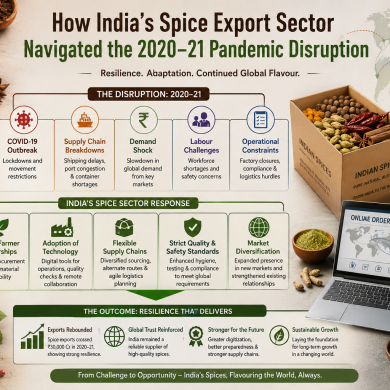
The period from 2020 to 2026 has been the most consequential half-decade in global agricultural trade since the formation of the WTO. Every structural assumption about supply chain resilience, origin concentration, and logistics reliability has been tested — and in many cases revised.
From the COVID-19 container crisis of 2020–21 to the Red Sea shipping disruption of 2023–25 and the US tariff shock of 2025–26, the cumulative effect of concurrent supply chain stresses has driven a fundamental rethink in how large food manufacturers, spice processors, and ingredient buyers manage their sourcing strategies. This overview maps the most significant changes and their implications for the India–origin trade specifically.
The Shift from Single-Origin to Multi-Origin Sourcing
The most visible structural change in global agri-commodity procurement over the past four years has been the deliberate move away from single-origin concentration toward multi-origin supplier portfolios. Before 2020, many large European food manufacturers had rationalised their supplier bases in pursuit of unit cost efficiency — concentrating volumes with fewer, larger suppliers, often from a single country of origin. The pandemic broke this model comprehensively.
The resulting procurement philosophy is one of structured redundancy: maintaining approved suppliers in two or three origin countries for each key ingredient, with clearly defined allocation rules that shift volume between origins based on price, quality, availability, and geopolitical conditions. For Indian agri-commodity suppliers — particularly in spices and dehydrated vegetables — this has created both a challenge and an opportunity. The challenge: Indian suppliers must now compete not just on price and quality but on supply chain transparency and reliability documentation. The opportunity: buyers who previously relied solely on Chinese or Vietnamese origin are actively qualifying Indian alternatives.
The US Tariff Effect: Accelerated Diversification
The Trump administration’s tariff schedule, which at its peak applied a 50% levy on Indian goods before being reduced to 10% by late February 2026, functioned as a forced diversification catalyst for Indian exporters. Exporters who had concentrated 60–70% of their US-facing volumes in a single product category or single US buyer relationship found themselves acutely exposed when those tariffs landed.
The market response was rapid. Indian spice exporters pivoted to Southeast Asian, Chinese, and European buyers within one to two shipping cycles — faster than most previous market disruption events had required. This agility was partly driven by necessity and partly by the improved logistics infrastructure and digital trade documentation systems that had been built out in the post-pandemic period.
TARIFF TIMELINE IMPACT ON INDIAN AGRI TRADE (2025–26)
- August 7, 2025 US imposes 25% tariff on Indian goods — initial market shock; buyers and exporters begin renegotiating contracts
- August 27, 2025 Tariff raised to 50% — peak disruption; marine, garment, and jewellery exporters most severely affected; agri exporters accelerate market diversification
- February 10, 2026 Tariff reduced to 18% — partial relief; some US buyers re-engage; agri volumes begin recovering
- February 24, 2026 Tariff further reduced to 10% — market stabilises; US re-emerges as viable destination but with more cautious buyer behaviour
The Red Sea Disruption: Logistics Re-Engineering
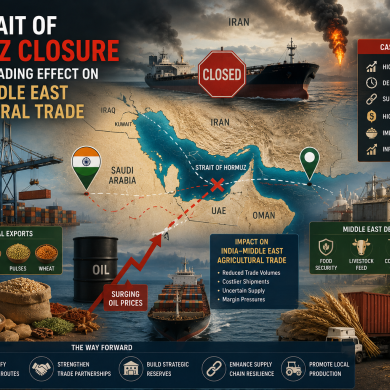
The Houthi attacks on commercial shipping in the Red Sea, which began in late 2023 and continued through 2025, forced a fundamental logistics re-evaluation for exporters whose primary trade routes passed through the Suez Canal. For Indian agri-commodity exporters serving European markets, the Suez route is the primary maritime corridor. The Red Sea disruption added 10–14 days to transit times and 30–40% to freight costs for vessels rerouted around the Cape of Good Hope — while simultaneously increasing war risk insurance premiums to levels not seen in recent decades.
The logistical response from Indian exporters varied significantly by product category and margin profile. High-value, lower-volume products — certified organic spices, premium dehydrated vegetables, specialty natural fibres — absorbed the additional freight cost and maintained shipment schedules, protecting long-term buyer relationships. Lower-margin commodity volumes faced more difficult economics: some contracts were renegotiated on freight-sharing terms, others were temporarily suspended pending logistics normalisation.
How Buyers Are Adjusting Supplier Qualification Criteria
Perhaps the most consequential long-term effect of the 2020–2026 disruption cycle has been the evolution of buyer supplier qualification criteria. Supply chain resilience metrics — which barely appeared in supplier assessment frameworks before 2020 — are now standard components of formal qualification processes at large food manufacturers.
NEW CRITERIA ENTERING BUYER QUALIFICATION FRAMEWORKS
- Business continuity documentation Formal evidence that the supplier has assessed and mitigated key supply chain risks — crop failure, logistics disruption, port closure, regulatory change
- Multi-port shipping capability Ability to route shipments through alternative Indian ports (JNPT, Mundra, Pipavav, Ennore) depending on congestion or disruption conditions
- Digital traceability systems Real-time shipment tracking, electronic documentation, and batch-level traceability are now standard expectations rather than premium features
India’s Structural Position in the Evolving Sourcing Landscape
Viewed through the lens of global buyer sourcing strategy, India’s competitive position in agri-commodities has evolved meaningfully through the 2020–2026 disruption cycle. The country’s geographic position — proximate to Gulf markets, with reasonable transit times to Europe and Southeast Asia — becomes more valuable as buyers weight logistics resilience more heavily in sourcing decisions.
The breadth and depth of India’s agri-commodity production — spanning spices, dehydrated vegetables, natural fibres, organic produce, and processed food ingredients — creates a one-stop-origin opportunity for buyers seeking to reduce the complexity of managing multiple origin supply chains. For buyers who have experienced the operational burden of managing concurrent disruptions across four or five origin countries, the appeal of a well-qualified, multi-category Indian supplier is substantial.
The buyers who navigated the 2020–2026 disruption period with the least damage were those who had invested in supplier relationships rather than merely supplier transactions. Relationship depth — built through in person meetings, joint quality improvement programmes, and direct communication — proved more valuable than any price advantage when conditions became difficult.
This observation applies symmetrically. Indian exporters who invested in buyer relationship development — transparency, rapid communication during disruptions, proactive documentation — maintained and in many cases deepened their market positions through the disruption cycle. Those who competed primarily on price, without the relationship infrastructure, experienced higher rates of order cancellation and buyer diversification away from Indian origin.
Add comment